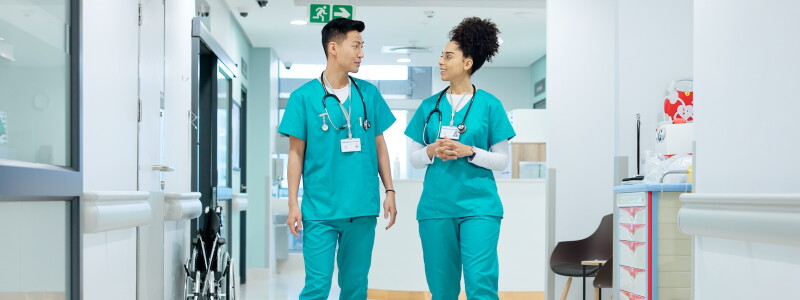
As a registered nurse, you already know how varied nursing practice can be. Your RN license can take you into hospitals, outpatient settings, home health, long-term care, and other environments, while additional education and experience can open paths into more specialized areas of practice.
Demand for nurses remains strong, but workforce needs are not identical across every setting or specialty. An aging population, anticipated nurse retirements, and changes in healthcare delivery are shaping where nurses are needed and the skills employers value.
This post looks at current demand for registered nurses, several specialty areas worth exploring, and ways a BSN can help you pursue your professional goals.
Key Takeaways
- Employment of registered nurses is projected to grow 6% from 2025 to 2035, with about 180,800 openings projected each year1
- Workforce changes, including anticipated retirements and an aging U.S. population, are contributing to continued demand for nurses2
- Specialty nursing roles may require specific clinical experience, certifications, or additional education
- A BSN program can expand your nursing knowledge and prepare you for graduate study and a wider range of professional responsibilities
Is Nursing in High Demand?
Registered nurses continue to face a favorable employment outlook. The U.S. Bureau of Labor Statistics (BLS) projects employment of registered nurses to grow 6% between 2025 and 2035, which is faster than the average for all occupations nationwide. The BLS projects about 180,800 openings for registered nurses each year over that decade, with many resulting from workers transferring to other occupations or leaving the workforce.1
Retirements contribute to this growing demand. The 2024 National Nursing Workforce Study found that approximately 40% of RNs indicated an intent to retire or leave nursing within the next five years.2 Those departures can create needs for nurses who are prepared to take on new responsibilities as their careers develop.
Demographic changes matter as well. As the U.S. population ages, nurses will continue caring for patients with chronic conditions and complex healthcare needs. Older adults may have multiple conditions that require coordinated care, making knowledge of age-related health needs increasingly important.
Technology is also changing how nurses deliver and coordinate care. Electronic health records, telehealth, remote monitoring, and other technologies have become part of healthcare delivery, requiring nurses to adapt while maintaining the clinical judgment and patient-centered approach at the heart of their work.
What Type of Nurses Are Most in Demand?
There is no single answer to which type of nurse is “most” in demand. Employment needs vary by location, employer, patient population, and care setting. Your interests, experience, education, and credentials also influence which specialty paths are available to you.
Some specialty roles require that you gain substantial clinical experience before earning an additional certification. Critical care offers one example. Nurses seeking the CCRN credential must hold a current, unencumbered U.S. RN or APRN license and meet specified clinical practice requirements before taking the certification exam.3
That distinction matters when you consider your own career path. A specialty credential generally does not substitute for clinical experience, and a BSN alone does not qualify you for every specialty role. Requirements vary, so the path into one area of nursing may look quite different from the path into another.
If you already know which patient population or practice environment interests you, research the requirements for that specialty. That knowledge can help you identify the steps that make sense for your career goals.
Top Nursing Specialties in Demand Today
Specialized career paths can include both traditional clinical roles and non-traditional nursing jobs in areas such as informatics, telehealth, and forensic nursing. Hiring needs change over time and from one healthcare market to another, but recent labor-market data can offer a snapshot of areas experiencing demand. An analysis of nursing job postings by Monster identified increased hiring activity in specialties including operating room nursing, critical care, and nurse anesthesia.4
Those roles are quite different from one another, however, and they do not share a single education or credentialing path. Rather than treating “specialty nursing” as one career category, consider the populations you want to serve, the environment in which you want to practice, and the additional preparation each role requires.
Critical Care and Emergency Nursing
Critical care and emergency nurses care for patients whose conditions may be serious, unstable, or rapidly changing. These environments call for strong assessment skills, clinical judgment, clear communication, and the ability to respond quickly as a patient’s condition changes.
If critical care interests you, experience is an important part of the path. Nurses in these settings may develop expertise in advanced monitoring, emergency interventions, and care for patients with complex or life-threatening conditions. Your RN experience can help prepare you for specialty certification, which provides another way to demonstrate expertise once you meet the relevant clinical requirements.3
Gerontology and Home Health Nursing
Gerontological nursing may involve caring for patients with chronic illnesses, cognitive changes, mobility limitations, and multiple health conditions that require coordinated care.5
You may encounter older adults in nearly every healthcare environment, but some nurses choose to concentrate their careers in long-term care, community-based services, or home health. These settings can require close attention to medication management, patient and family education, safety, functional needs, and coordination among multiple healthcare professionals.
Home health nursing brings care directly into a patient’s living environment. That can give you a different view of the factors affecting health and recovery, from a patient’s ability to follow a care plan to the resources and assistance available at home.
How Education Unlocks In-Demand Nurse Specialties
You have already completed the education and licensure requirements necessary to become an RN. A BSN builds on that foundation rather than starting your education over.
Bachelor’s-level nursing education can broaden your perspective on areas such as evidence-based practice, population health, leadership, healthcare systems, and the social and cultural factors that influence patient care. It can also expand the range of jobs you can pursue and position you for further education. If your long-term goals include advanced practice nursing, nursing education, administration, or another graduate-level path, a bachelor’s degree is the academic prerequisite you'll need to complete.
Specialty career development is rarely the result of one credential alone. Your RN experience, continued education, clinical expertise, and certifications can complement one another as you decide where you want your nursing career to go.
Build on Your RN Experience for a Specialty Nursing Career
You already bring education and professional experience to your career. Oklahoma City University’s Kramer School of Nursing offers an online RN-BSN program designed to help you expand your knowledge and skills.
The program combines asynchronous coursework with content you can apply to your nursing practice. Experienced faculty bring real-world perspectives to the classroom, while interaction with peers gives you opportunities to learn from nurses whose backgrounds and professional experiences may differ from your own.
You can complete the online RN-BSN in as few as 12 months. Applicants must hold an active, unencumbered U.S. RN license and have graduated from an associate degree RN program approved by a state board of nursing, along with meeting the program’s other admissions requirements.
Whether you want to explore a specialty, prepare for greater responsibility, or pursue graduate study, completing your BSN can broaden your knowledge and expand your professional options.
To learn more about Oklahoma City University’s online RN-BSN, contact us directly or schedule a call with an admissions outreach advisor today.
- Retrieved on September 7, 2026, from bls.gov/ooh/healthcare/registered-nurses.htm#tab-6
- Retrieved on September 7, 2026, from ncsbn.org/public-files/2024-NCSBN-WorkforceSurvey-Infographic.pdf
- Retrieved on September 7, 2026, from aacn.org/certification/get-certified/ccrn-adult
- Retrieved on September 7, 2026, from monster.com/career-advice/research/nursing-labor-market-trends
- Retrieved on September 7, 2026, from indeed.com/career-advice/finding-a-job/geriatric-nursing